Parenting Time Calculator: Overnights and Custody Percentage
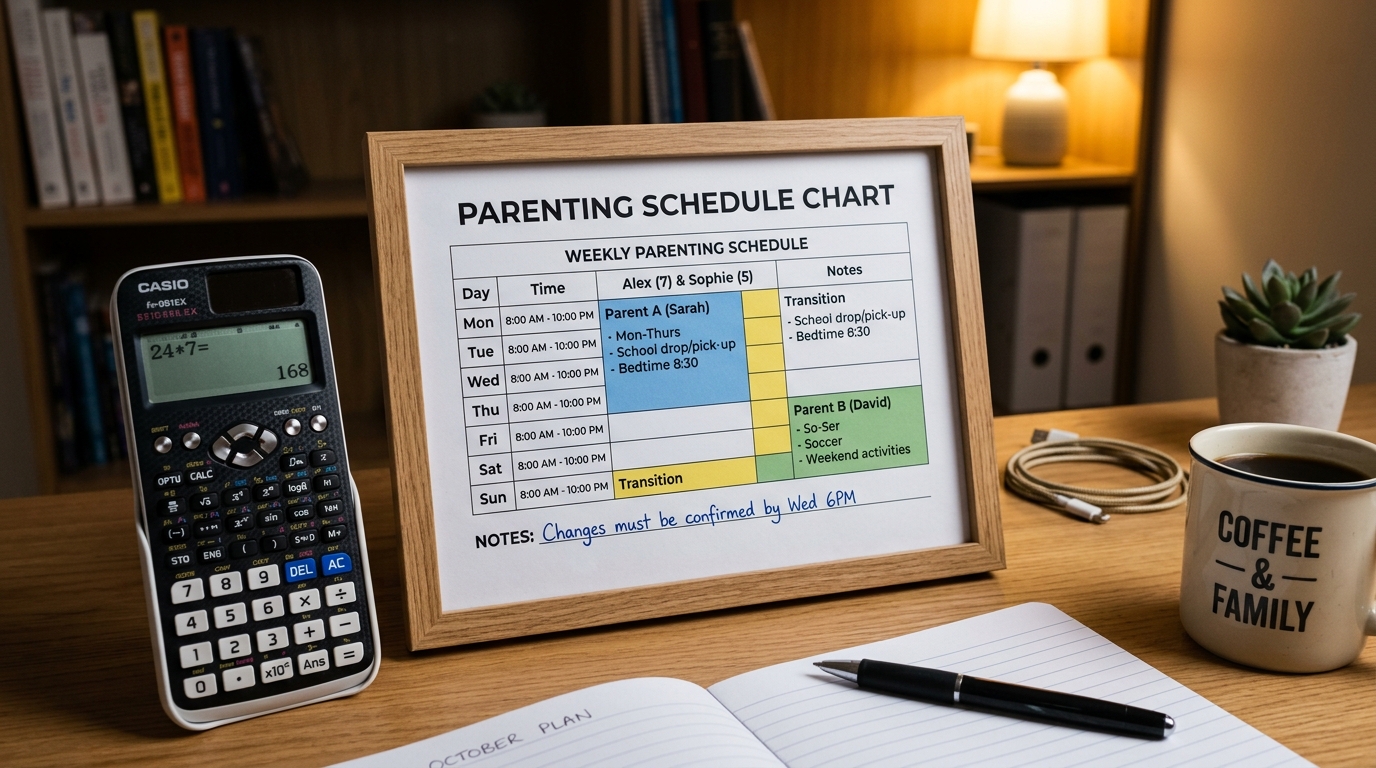
Parenting time is counted in overnights: divide the nights the child sleeps at one parent's home by the nights in the period, and multiply by 100. On that basis alternating weeks, 2-2-3, 2-2-5-5 and 3-4-4-3 all come out at exactly 50.0% / 50.0% over a 14-day rotation; every other weekend is 14.3% (2 of 14 nights) or 21.4% if the weekend runs Friday night to Monday morning; a 4-3 week is 57.1% / 42.9%. The round labels parents use are approximations of these same overnight counts, not separate schedules: an 80/20 arrangement is closest to every other weekend running Friday night to Monday morning (3 of 14 nights, 21.4%); 70/30 is closest to that plus one midweek overnight a week (4 of 14, 28.6%); and 60/40 is closest to a 4-3 week (3 of 7, 42.9%). Across a full year the halves shift by one night — 183 against 182, or 50.1% / 49.9% — because 365 is not divisible by 14.
The calculator below does the arithmetic for whichever pattern you actually use. Pick one of the 14 schedules SplitDay ships with, or build your own two-week pattern, and you get the exact percentage split, the overnight counts and how it lands across a real 12-month calendar. Nothing you enter leaves your browser.
Parenting time calculator
Counted in overnights — the basis most courts, guidelines and custody apps use. Everything runs in your browser: nothing you enter is sent anywhere or stored.
The first night of Parent A's first block. Changing the weekday shifts the whole pattern.
The rotation, night by night
Each box is one overnight. Select a box to change who has that night — the schedule switches to a custom pattern.
How parenting time is counted
Most family courts, child-support guidelines and custody apps count overnights, not hours. An overnight is one night the child sleeps at that parent's home, and every night belongs to exactly one parent — which makes the count unambiguous and something both households can check against the same calendar. Hours are harder: a Wednesday dinner from 5 to 8 p.m. is real parenting time, but it is not an overnight, and two people counting hours will rarely land on the same number.
That is also why you will see very different figures quoted for the same schedule. Every other weekend is often described as "about 28%". Counted in overnights it is 2 nights out of every 14 — 14.3% — if the child comes home on Sunday evening, and 3 out of 14 — 21.4% — if the weekend runs from Friday night to Monday morning. The larger numbers come from counting part-days or daytime hours. Before you quote a percentage to anyone, find out which basis they use, and then use that one consistently.
What each schedule works out to
These are the 14 rotations SplitDay ships with, calculated over one complete cycle. Parent A is the parent whose block the rotation starts with.
| Schedule | Rotation length | Nights (A / B) | Overnight split |
|---|---|---|---|
| 2-2-3 | 14 days | 7 / 7 | 50.0% / 50.0% |
| 2-2-5-5 | 14 days | 7 / 7 | 50.0% / 50.0% |
| 3-4-4-3 | 14 days | 7 / 7 | 50.0% / 50.0% |
| 4-3-3-4 | 14 days | 7 / 7 | 50.0% / 50.0% |
| 3-3-4-4 | 14 days | 7 / 7 | 50.0% / 50.0% |
| 3/4 day swap | 14 days | 7 / 7 | 50.0% / 50.0% |
| Alternating weeks (week on / week off) | 14 days | 7 / 7 | 50.0% / 50.0% |
| 4-3 | 7 days | 4 / 3 | 57.1% / 42.9% |
| Extended weekend (Fri–Sun) | 7 days | 4 / 3 | 57.1% / 42.9% |
| Every third week | 21 days | 14 / 7 | 66.7% / 33.3% |
| Every third day | 3 days | 2 / 1 | 66.7% / 33.3% |
| Every weekend | 7 days | 5 / 2 | 71.4% / 28.6% |
| Every other weekend | 14 days | 12 / 2 | 85.7% / 14.3% |
| 1st, 3rd & 5th weekends | 28 days | 24 / 4 | 85.7% / 14.3% |
Weekend schedules here treat the weekend as Saturday and Sunday nights. If your weekend starts Friday night, tick "Weekend runs from Friday night" in the calculator: every other weekend becomes 78.6% / 21.4% and every weekend becomes 57.1% / 42.9%. The 1st, 3rd and 5th weekends pattern is modelled as a four-week rotation; in a real calendar the occasional fifth weekend adds two or three weekends a year, which lifts the smaller share by roughly one percentage point.
Alternating weeks is exactly 50/50
You may read that week-on/week-off works out to 53/47 because the week-on parent "gets the extra weekend". That is not what the arithmetic does. Over one full 14-day rotation each parent has exactly 7 nights and exactly one weekend — 50.0% / 50.0%. Our guide to the alternating weeks schedule sets out the same rotation night by night.
The small imbalances that do show up come from the calendar, not the pattern. A 365-day year is not divisible by 14, so whichever parent's week the year happens to start and end on finishes one night ahead: 183 nights against 182, which is 50.1% / 49.9%. Holidays, school breaks and summer move far more time than that. The calculator shows both numbers — the exact rotation percentage, and the count across whatever date range you choose — so you can see the difference for yourself.
Why the percentage matters
Child support
In many jurisdictions the parenting-time percentage feeds directly into the child-support calculation, and some guidelines have thresholds — a set number of overnights a year — where the formula changes. Which basis is used, where the thresholds sit and whether they apply at all varies by country and often by state or province. Treat any number you get here as a starting point for the conversation with your attorney or your local guideline worksheet, not as an answer. Our guide to child support under a 50/50 schedule covers the usual questions.
Changing an order
In many jurisdictions a lasting gap between the schedule on paper and the schedule you are actually living can support a request to change the order. But the legal standard, the evidence expected and how long the gap has to have lasted differ enormously from place to place, and a percentage on its own is rarely enough. Ask your attorney what would carry weight where you live before you act on a number.
US taxes
In the United States, IRS Publication 501 sets out a residency test for which parent is the custodial parent: the child is treated as living with the parent they spent the greater number of nights with during the year. That is the same overnight count this calculator produces. Publication 501 also covers what happens when the nights come out equal and how Form 8332 lets the custodial parent release the claim to the other parent. Read the current version on irs.gov and speak to a tax professional about your own situation.
Knowing rather than guessing
Most parents who feel they have "about half" have never counted. Sometimes the number is reassuring and sometimes it is not, but either way it replaces an argument about impressions with a figure both households can verify on the same calendar — which tends to make the conversation shorter.
From a model to what actually happened
The calculator on this page models a schedule. Real life deviates from it: swaps, sick days, a missed handover, an extra week in summer. If you want the number that describes your year rather than your rotation, you have to log what actually happened. That is what SplitDay does:
- A custody calendar built from the same 14 rotations, plus custom patterns
- A running split that updates as each exchange is logged
- An exchange log with timestamps, so the record is built as you go
- CSV export of your full custody history — on every plan, including the free one
- Works offline, and holiday presets for 12 countries
Consistent records are easier to talk about than recollections. What any court or mediator will accept is a question for your attorney. If you want to see how your split compares with other families, our custody split statistics show which arrangements separating parents actually choose, and how to track custody days covers the day-to-day habit.
Frequently asked questions
How do courts count parenting time?
Most courts and child-support guidelines count overnights — the number of nights the child sleeps at each parent's home over a year. Every night belongs to exactly one parent, so the count is unambiguous and both households can check it against the same calendar. Some jurisdictions count days or hours instead, or use their own worksheet, so confirm which basis applies where you live before quoting a percentage.
Is alternating weeks 50/50?
Yes. Over a full 14-day rotation, week-on/week-off gives each parent exactly 7 of the 14 overnights, including one weekend each — 50.0% for each parent. The claim that it works out to 53/47 is wrong. Across a calendar year one parent may end up with 183 nights and the other 182, simply because 365 does not divide by 14, which is 50.1% against 49.9%.
What percentage is every other weekend?
Counted in overnights, every other weekend is 2 nights out of every 14 — 14.3% — if the child comes home on Sunday evening, and 3 out of 14 — 21.4% — if the weekend runs from Friday night to Monday morning. Adding one midweek overnight every week adds 2 nights a fortnight, which takes those figures to 28.6% and 35.7%. Higher numbers you may see quoted usually come from counting part-days rather than nights.
Do hours or overnights matter more?
Overnights are the standard measure and the one this calculator uses: they are countable, they map onto a calendar and they are what most guidelines ask for. Hours still matter for how a child experiences the week — a parent doing every school run and every homework hour has real involvement that an overnight count does not show — but hours are hard to count consistently. Use overnights for the number, and describe the hours separately if they are part of your case.
Compute your split, then keep it honest
Run your own pattern through the calculator above to get the exact percentage — it is free, needs no account, and nothing you type leaves your browser.
The calculator models the schedule on paper. If you want the number that describes the year you actually lived, SplitDay counts the overnights as you log each exchange and exports the full history as CSV on every plan, including the free one.