Custody Schedules by Age: What Works From Infancy to the Teen Years
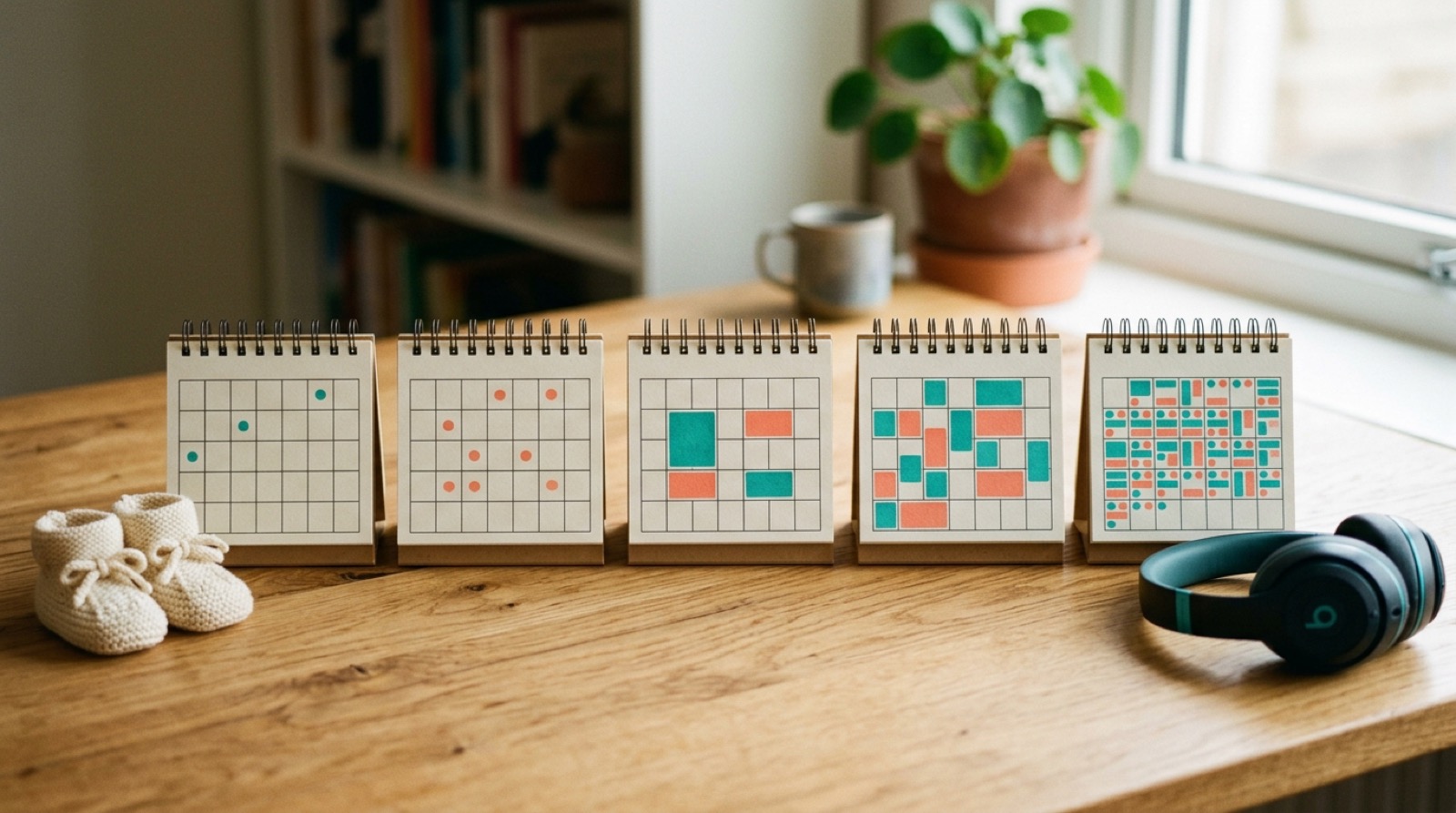
Custody schedules change with a child's age on one principle: younger children need shorter gaps between seeing each parent, older children can handle longer, more stable blocks. In practice that means frequent short visits with overnights added gradually for infants under 18 months; 2-2-3 or similar short blocks for toddlers, keeping the longest gap to two or three days; 2-2-3 or 3-4-4-3 for preschoolers aged 3–5; week-based patterns such as 2-2-5-5, split week or alternating weeks once school anchors the week at 6–12; and alternating weeks with real flexibility for teenagers aged 13–18, whose own schedule now drives the calendar.
Each age band below is covered in a dedicated guide, and the table that follows compares them side by side. Treat the ages as a starting point rather than a rule — distance between homes, work shifts and a child's temperament move the answer as much as age does.
Custody schedule by age, at a glance
The table below is a starting point, not a rule. The "longest gap apart" column reflects general guidance many family professionals give — the maximum stretch away from either parent that most children of that age handle comfortably.
| Age | Typical patterns | Longest gap apart (general guidance) | What matters most |
|---|---|---|---|
| 0-18 months (infant) | Frequent short visits; overnights introduced gradually | ~1-3 days | Predictable feeding & sleep; secure attachment to both parents |
| 18 months-3 years (toddler) | 2-2-3, short blocks, first regular overnights | ~2-3 days | Consistent routines, comfort objects, easy handoffs |
| 3-5 years (preschool) | 2-2-3 or 3-4-4-3, longer weekends | ~3-4 days | Words for the schedule; both homes feel like home |
| 6-12 years (school age) | Week-based (2-2-5-5), alternating weeks, split week | ~up to 1 week | School stability, activities, friendships across both homes |
| 13-18 years (teen) | Alternating weeks, flexible or teen-led plans | ~1-2 weeks | Autonomy, social life, having a real say in the plan |
Infants: 0-18 months
Custody schedules for infants aged 0–18 months use frequent, short contacts rather than long blocks, with overnights added gradually. Babies build attachment through repeated, predictable contact — being fed, soothed and put to sleep by both parents, over and over. Long gaps are hard because an infant has little sense of "Mom comes back on Friday." The usual approach is several shorter visits across the week, with overnights added gradually as the baby and both parents are ready. Feeding, especially breastfeeding, shapes the plan more than any template. Our dedicated guide covers this stage in depth: infant custody schedules (0-18 months).
Toddlers: 18 months to 3 years
Custody schedules for toddlers aged 18 months to 3 years keep the longest gap apart to about two or three days, which is why the 2-2-3 rotation is the common choice at this age. Toddlers can handle a bit more time apart than infants and usually manage their first regular overnights, but they still do best when the longest gap stays short — a few days at most. This is where the 2-2-3 schedule becomes popular: it splits the week so a child never goes more than two or three days without seeing either parent, while giving each home a consistent rhythm. Familiar routines and a well-traveled comfort object (the same blanket in both homes) make handoffs far easier. Read the full toddler schedule guide.
Preschoolers: 3 to 5 years
Custody schedules for preschoolers aged 3 to 5 usually stay on 2-2-3 or move to a slightly longer pattern such as 3-4-4-3, keeping the longest gap to about three or four days. Preschoolers now have language for the schedule — "two sleeps at Dad's, then Mom's" — and can hold a slightly longer stretch in mind. Many families stay with 2-2-3 or move to a pattern like 3-4-4-3, which adds a little length without long absences. The goal at this age is that both places genuinely feel like home: their own toothbrush, clothes and bed in each house, and a predictable pattern they can start to anticipate. Read the full preschooler schedule guide.
School-age children: 6 to 12 years
Custody schedules for school-age children aged 6 to 12 can move to week-based patterns — 2-2-5-5, a split week, or full alternating weeks — because school now anchors the week and longer blocks become realistic. This is the age where week-based schedules open up: a 2-2-5-5 rotation, a split week, or full alternating weeks for kids who are ready. Fewer handoffs mean fewer forgotten cleats and permission slips, but the trade-off is longer time away from one parent — a midweek dinner or call keeps that gap from feeling too big. School location, activities and friendships now weigh heavily on which home a child is in on any given night. Read the full school-age schedule guide.
Teenagers: 13 to 18 years
Custody schedules for teenagers aged 13 to 18 usually run on alternating weeks with deliberate flexibility built in, because a teenager's own commitments now drive the calendar. Teens can handle the longest blocks — often alternating weeks — but the bigger shift is that their own life now drives the calendar. Jobs, sports, study groups and friends are tied to specific places and times, and a rigid plan that ignores them tends to quietly fall apart. Most family professionals suggest keeping a stable framework while giving a teen a genuine voice and some flexibility, so the schedule bends around their life instead of breaking. Read the full teenager schedule guide.
Does shared custody actually help kids?
A common worry is whether moving between two homes is hard on children. The research is broadly reassuring. A 2018 review of 60 studies found that children in joint physical custody did better than those in sole custody on all measured outcomes in 34 studies, equal or better in another 14, and worse in only 6. One of the largest single studies — a Swedish survey of 147,839 adolescents — found that teens living in joint physical custody reported fewer psychosomatic problems (headaches, stomachaches, trouble sleeping) than those living mostly with one parent. Shared arrangements have also become far more normal: in the United States, the share of separations resulting in shared custody rose from about 13% in 1985 to 34% in recent years. None of this means two homes are automatically easy — but it does mean an age-appropriate shared schedule is a well-supported choice, not a risky one.
No template fits everyone
Age is a guide, not a formula. In a 2026 SplitDay study of 804 separating families, 42% chose an equal 50/50 split — but 46% ended up building a fully custom weekly schedule rather than using any standard template. Distance between homes, work shifts, school location and each child's temperament all bend the "ideal" schedule into something specific to you. Treat the ages above as a place to start, then adjust. If you want to see the trade-offs of each pattern side by side, our custody schedule maker guide walks through them by age and distance.
Frequently asked questions
What is the best custody schedule for young children?
For babies and toddlers, many family professionals suggest frequent, shorter contacts rather than long stretches apart, because young children rely on repeated, predictable contact to stay connected to each parent. Patterns like 2-2-3 that keep the longest gap to a few days are popular for this age. As children reach school age they can usually handle longer, more stable blocks.
When can a child start alternating weeks?
There is no fixed cutoff, but many families and professionals wait until a child is school-aged — roughly 6 and up — before moving to week-on, week-off, because a full week is a long time away from either parent for a younger child. Some families ease into it with a midweek visit or call so the gap never feels too long. Temperament and how far apart the homes are matter as much as age.
Should teenagers choose their own custody schedule?
Teens rarely get the final say, but most family professionals suggest giving them a real voice. By 13-18, school, jobs, sports and friendships are anchored to specific places and times, and a plan that ignores them tends to break down. Many families keep a stable framework — often alternating weeks — but build in flexibility so a teen is not forced to miss things that matter.
How often should we revisit the custody schedule?
A good rule of thumb is to review the schedule at each major stage — infant to toddler, starting school, and the teen years — and any time a big change happens, like a move or a new school. A schedule that fit a 3-year-old is rarely right at 13. Revisiting it on purpose, rather than waiting for it to break, keeps both homes and the child on the same page.
Build a schedule that grows with your child
Set the pattern that fits your child's age today, and adjust it in seconds as they grow. Both homes see the same calendar. Free to start.
Not sure which pattern your child’s age points to? Start with the age guide that fits — infant, toddler, preschooler, school-age or teenager — then check the exact overnight split with the free parenting time calculator.