Who Gets the Kids for Christmas? Holiday Custody Rotations That Work
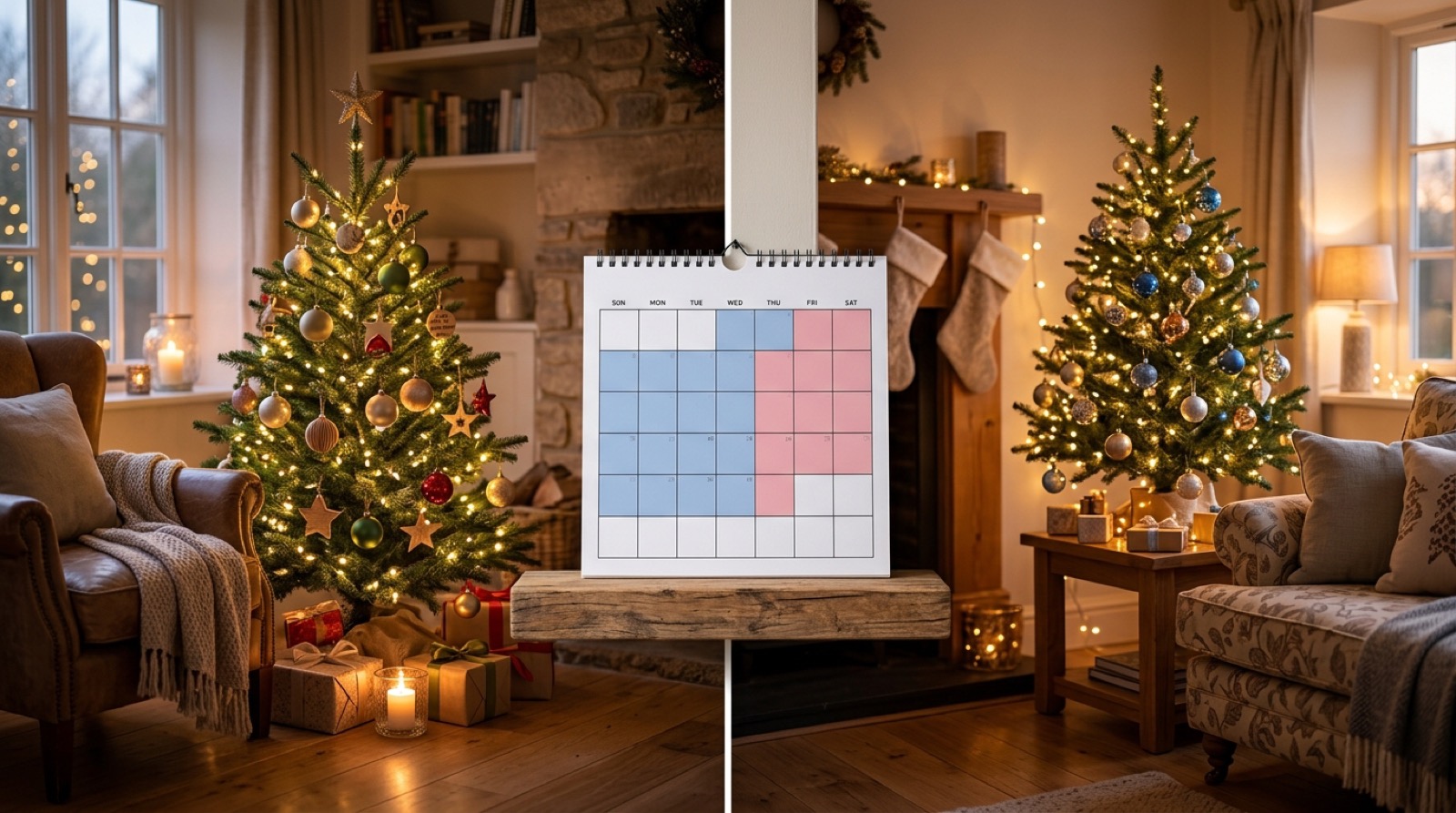
Most separated parents solve Christmas one of three ways: alternate the whole holiday by even and odd years (one parent gets Christmas this year, the other gets it next year), split the day itself (Christmas Eve and morning with one parent, Christmas afternoon and Boxing Day with the other), or double-celebrate — hold two Christmases on different days so the kids get the full holiday twice. There is no single right answer. The best one depends on how far apart you live, how old the kids are, and how each side's extended family does the holiday.
The four approaches at a glance
| Approach | How it works | Best when |
|---|---|---|
| Alternate whole holiday | One parent has the entire Christmas block; it flips each year by even/odd | You live far apart, travel is involved, or a single handoff on the day is too much |
| Split the day | Eve and morning with one parent, a midday handoff, afternoon with the other | The two homes are close and both families want to see the kids on the 25th |
| Double Christmas | Two separate celebrations on different days — e.g. the 25th with one, the 27th with the other | Kids are younger, both homes want their own full day, and dates can flex |
| Fixed by tradition | The same parent has Christmas every year, by agreement (the other takes another key holiday) | One side's Christmas traditions matter far more, and the trade is genuinely balanced |
The even/odd year convention, explained
Alternating by even and odd years is the workhorse of holiday scheduling, because it is dead simple to remember and almost impossible to argue about. You assign one parent the even-numbered years for Christmas and the other the odd-numbered years. Set it once and it runs for a decade without another conversation.
Here is how it plays out concretely. Say Parent A takes Christmas in even years and Parent B in odd years:
- 2026 (even): The kids are with Parent A. If you are also splitting the day, Parent A has Christmas Eve and Christmas morning, then the handoff is at 2:00 p.m. on the 25th and Parent B has the afternoon and Boxing Day.
- 2027 (odd): Everything flips. Parent B now has Christmas Eve and the morning; the 2:00 p.m. handoff runs the other direction, and Parent A takes the afternoon.
- 2028 (even): Back to the 2026 pattern — and so on.
The same even/odd logic handles the "who goes first" problem for whichever pieces you decide to split: the Christmas Eve sleepover, the morning stockings, the big family dinner. Pin down a fixed handoff time and place in advance — "2:00 p.m. at the halfway point" — so nobody is negotiating logistics on Christmas morning itself.
Travel years: fold Christmas into the school break
If one parent has the kids for Christmas and lives far away, the holiday is really a travel block, not a single day — and it makes far more sense to think about the whole winter school break at once. Rather than a frantic drop-off on the 25th, the parent whose Christmas it is often takes a longer stretch of the vacation around it, and the pattern reverses next year. That way the long-distance trip is worth making, and the child gets real, unhurried time rather than a hand-off in a car park.
Coordinating Christmas with the rest of the winter holiday is exactly the kind of thing that gets messy if you improvise. Our school vacation split guide covers how to divide the whole break — first-half/second-half swaps, who travels which year, and how to keep the regular schedule from colliding with the holiday block.
Decide in autumn, not December
The single biggest predictor of a calm Christmas is when you settled it. Families who sort the rotation in October are choosing between good options; families still arguing in mid-December are choosing between bad ones, with flights booked and grandparents already asking. Lock the plan while it is still abstract and nobody is emotional about it.
Putting it in writing does not have to be a legal ordeal — it just has to be clear and shared. Decide the approach (alternate, split, or double), write down the even/odd assignment, and set the exact handoff time and place. Our holiday rotation calculator does the fiddly part for you: tell it who has this year and it maps out which parent has Christmas — and every other holiday you set — for years ahead, so there is nothing left to interpret.
Put the kids first: two Christmases is a feature
It is easy for adults to see a split holiday as something lost. Kids usually don't. For a child, the double Christmas that co-parenting makes possible — one celebration at each home, two mornings of stockings, two sets of grandparents who are genuinely glad to see them — is a genuinely good deal, provided the grown-ups don't frame it as a consolation prize.
A few things make it land well. Keep the tone generous: let the kids be excited about the other home's Christmas in front of you. Don't compete on presents or turn the day into a scoreboard. And give them a countdown they can see — "Christmas morning here, then the lights go on the tree at Dad's on the 27th" — so the shape of the holiday is predictable and warm rather than a surprise. A holiday that is planned early, written down, and spoken about kindly is one kids remember for the fun, not the friction.
Frequently asked questions
Who gets the kids for Christmas the first year after divorce?
There is no automatic rule — it is whatever the two parents agree to, or whatever a parenting plan or court order sets out. A common fair approach is to decide who takes the first Christmas and then alternate every year after that, so each parent knows years in advance which Christmases are theirs. Some families instead split the day itself that first year. The key is to agree in writing early, not in December.
How do you split Christmas Day between two parents?
The usual method is a single handoff. One parent has Christmas Eve and Christmas morning, then hands the child over around midday or early afternoon on Christmas Day, and the other parent has the rest of the day and often Boxing Day. Pick a fixed handoff time and a neutral or convenient location, and write both into the plan so nobody is negotiating on the morning itself. Splitting the day works best when the two homes are close enough to make a mid-day drive easy.
What is the even and odd year custody rotation?
It is a simple way to alternate holidays fairly. One parent is assigned the even-numbered years for a holiday and the other parent the odd-numbered years. For example, if one parent has Christmas in even years, they have it in 2026 and 2028, while the other parent has 2027 and 2029. It is easy to remember, hard to argue about, and can be set once and left to run for years.
Should Christmas follow the regular custody schedule?
Usually not. Most families treat Christmas as a holiday exception that overrides the normal weekly pattern, so that whose turn it happens to be does not decide the whole holiday. You set a separate holiday rotation for Christmas (and other key dates), and the regular schedule simply resumes once the holiday block ends.
Set the Christmas rotation once
Pick who has Christmas this year, let the rotation run for years, and everyone — kids included — sees the same calendar. Free to start.
Sorting out the holidays with your co-parent right now? Share this with them and settle Christmas in one sitting.