50/50 Custody Schedule: A Simple Guide for Co-Parents
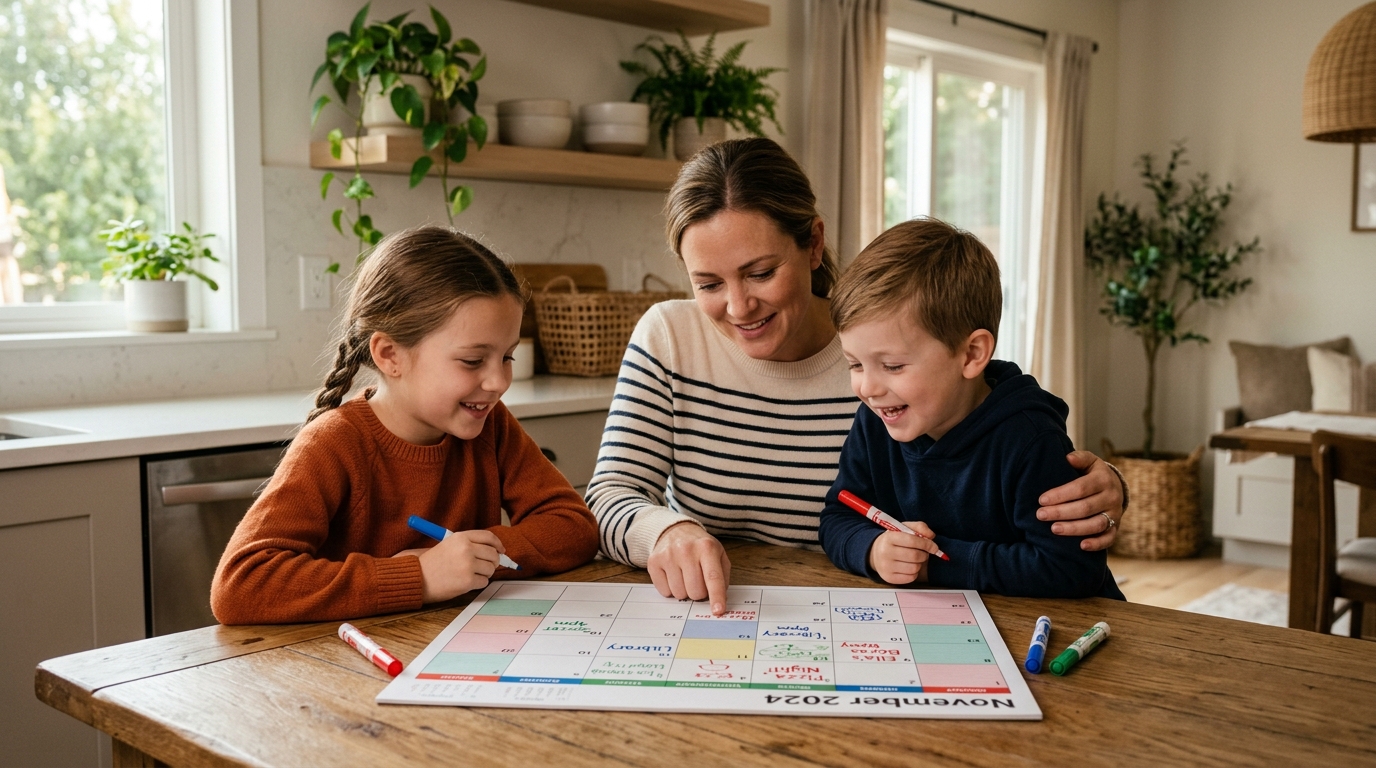
A 50/50 custody schedule means each parent has the kids exactly half the time — 7 overnights out of every 14 days — with the most common patterns being 2-2-3, 2-2-5-5, 3-4-4-3, and alternating weeks. It's the most common arrangement when both parents stay involved after a separation, and it works best when parents live close enough that the kids can move between homes without disrupting school or activities.
The generator below builds any of the main 50/50 patterns as a real, print-ready calendar so you can see how each one falls on your actual weeks before you commit. Set each parent's name and color, switch the rotation, and print or save it. Everything runs in your browser — nothing is uploaded or saved.
Free printable custody calendar generator
Set it up, then press Print. Runs entirely in your browser — no sign-up, nothing stored.
The day Parent A's first block begins.
Made with SplitDay · splitday.com
Equal time, four different shapes
"50/50" only tells you the total: 7 overnights each per fortnight. It says nothing about how those overnights are arranged, and that arrangement is what your family actually lives with day to day. The same equal split can mean a handoff every two or three days, or a single handoff each week. The four patterns below all reach 50/50 — they just trade off differently on the two things that matter most: how many exchanges you do, and the longest stretch a child goes without seeing one parent. More exchanges keep that stretch short (good for little kids) but ask more of the co-parents; fewer exchanges are calmer logistically but leave a child away from one parent for up to a week.
| Pattern | Exchanges / week | Longest time away from a parent | Best for |
|---|---|---|---|
| 2-2-3 | ~3 (many) | 3 days | Toddlers and young kids who can't handle long gaps |
| 3-4-4-3 | ~2 (one midweek + weekend) | 4 days | Elementary-age kids; a calmer step up from 2-2-3 |
| 2-2-5-5 | ~2 (fixed weekdays) | 5 days | Families who want the same weeknights every week |
| Alternating weeks (7/7) | 1 (fewest) | 7 days | Tweens and teens; longer distance between homes |
How the four patterns actually run
2-2-3 gives Parent A the first two days, Parent B the next two, and then a three-day block that alternates each week, so weekends swap. Nobody is ever more than three days away, which is exactly why it suits toddlers — but it means a handoff every two to three days, and it needs two parents who can hand off smoothly and often. It's the most demanding pattern on the adults and the gentlest on very young children.
3-4-4-3 cuts the frequency roughly in half. Each parent gets a three-day stretch one week and a four-day stretch the next, with a single midweek exchange plus the weekend changeover. Max time apart rises to four days. It's the natural "graduation" schedule for kids who have outgrown 2-2-3 but aren't ready for a full week away.
2-2-5-5 fixes the weeknights: one parent always has Monday–Tuesday, the other always has Wednesday–Thursday, and the weekend blocks alternate to make each side's time a 5-day run every other week. Families love it because the weekday routine never changes — the same parent is always at Tuesday soccer — even though the longest gap stretches to five days.
Alternating weeks (also called week-on / week-off or 7/7) is the simplest: one exchange, usually Friday after school or Sunday evening, and then a clean week with each parent. It has the fewest handoffs of any 50/50 plan and travels well over distance, but a young child can find seven days away from a parent too long. It shines with teenagers, who often prefer the stability of a full week in one place.
How to choose the right one
Three questions settle it for most families:
- How old is the child? The younger the child, the shorter the gap they can tolerate. Under 6, lean toward 2-2-3 or 3-4-4-3. Elementary age is comfortable with 3-4-4-3 or 2-2-5-5. Tweens and teens usually do best on alternating weeks, and often ask for it themselves. See the custody statistics for how common each arrangement is by age.
- How far apart do you live? Frequent-exchange patterns like 2-2-3 assume both homes are a short drive from the same school. The farther apart you live, the more each handoff costs in time and traffic — which pushes you toward 2-2-5-5 or alternating weeks, where there are fewer exchanges to make.
- How well do handoffs go? Be honest about this one. If exchanges are tense or logistically fragile, a plan with a handoff every two days multiplies the friction. Fewer, more predictable exchanges (2-2-5-5, alternating weeks) reduce the number of moments where things can go wrong.
A common path is to start younger children on 2-2-3, move to 3-4-4-3 around school age, and shift to alternating weeks in the teen years — same 50/50 split the whole way, just fewer exchanges as the child grows. If you're unsure, use the generator above to print a month of each candidate pattern and see which one lands your weekends, activities, and work weeks where you need them.
Whether a court will order this schedule depends on the law where you live — for the United States, see child custody law in the United States.
Frequently asked questions
Which 50/50 schedule is best for young kids?
Younger children, especially under 6, usually do better with shorter blocks like 2-2-3 or 2-2-5-5, so they never go too long without seeing either parent. Older kids and teens can typically handle week-on / week-off, especially when both homes feel like home and the schedule stays predictable. The right pattern also depends on work schedules and how smoothly handoffs go.
Does 50/50 custody mean no child support?
Not necessarily. Child support rules vary by jurisdiction, and many places consider both parents' incomes alongside parenting time. Even with equal overnights, the higher-earning parent may still owe support. A 50/50 schedule can reduce the amount in some jurisdictions, but it rarely eliminates the obligation automatically. Check your local guidelines or ask a family law professional about your specific situation.
How far apart can parents live for 50/50 to work?
There's no fixed distance, but 50/50 works best when both homes are close enough that the kids can reach the same school, friends, and activities from either house — often the same town or a short drive apart. Frequent-exchange patterns like 2-2-3 get harder with longer commutes, so parents who live farther apart tend to prefer alternating weeks.
Try SplitDay — the free custody calendar app
Track custody days, log exchanges, and print kid-friendly calendars. The simplest co-parenting app — no ex required. Free to start.